
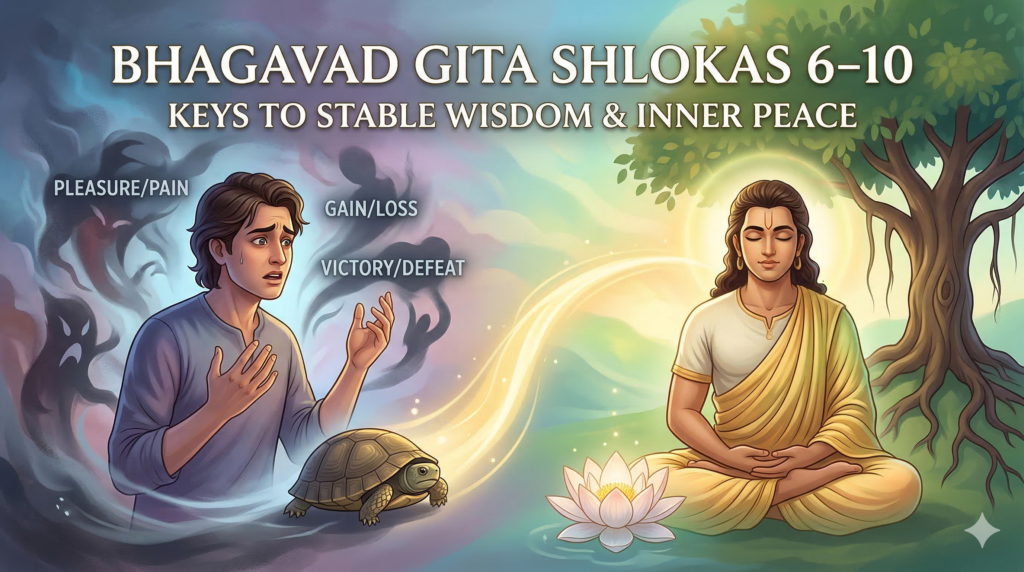
When Power Speaks… But Peace Is Missing
In Bhagavad Gita Shlokas 6-10,
The battlefield of Kurukshetra (Mahabharat) is not merely a physical space—it is a stage where the deepest layers of the human psyche begin to unfold.
The conch shells have been blown. Armies stand face to face. The air is thick—not just with anticipation of war, but with emotion, ego, duty, and destiny.
In this charged moment, Duryodhana continues speaking to his guru, Dronacharya. His words are carefully chosen, layered with admiration, strategy… and something more subtle—unease.
The Shlokas (6–10) – Essence
In these verses, Duryodhana lists the powerful warriors on his side—names like Bhurishrava, Vikarna, Ashwatthama, and many other great fighters. Each name represents strength, loyalty, and years of training in warfare. He proudly declares that his army is vast, well-equipped, and filled with heroes willing to sacrifice their lives for his cause
But then, almost unexpectedly, he says something revealing. He instructs everyone to protect Bhishma carefully.
At first glance, this might seem like a strategic move—after all, Bhishma is the most powerful and experienced warrior on the Kaurava side. But if we look deeper, a question arises.
If the army is truly so strong… why this anxiety?
Why this emphasis on protecting one man?
Because even in the loudest declarations of confidence, the quiet voice of fear finds its way through.
The Hidden Emotion Beneath Confidence
Duryodhana’s speech is fascinating because it reflects a very human tendency. When we feel uncertain, we often try to compensate by sounding more confident than we truly are. His listing of warriors is not just information, it is reassurance. Not just for Dronacharya, but for himself.
This is not the calm confidence of someone rooted in truth.
This is the restless confidence of someone trying to hold control.
Insight: The Illusion of Strength
Outward strength can be very convincing.
Large armies, powerful allies, impressive resources—these are all visible signs of success.
But the Bhagavad Gita invites us to look beyond what is visible.
Duryodhana’s strength is external. It is built on numbers, alliances, and comparison with the Pandavas. But inner strength—true strength—comes from alignment with dharma (righteousness), clarity of purpose, and peace within. And that is what is missing.
Analogy:
Imagine a grand palace, beautifully decorated, glowing under golden light. From the outside, it looks magnificent. But its foundation is weak.
No matter how impressive it appears, one strong tremor is enough to shake everything.
In the same way, a life built only on external success but lacking inner alignment will always carry a subtle instability.
A Deeper Look at Bhishma’s Mention
Bhishma is not just any warrior. He is a symbol of discipline, sacrifice, and unmatched skill.
Duryodhana’s instruction to protect him reveals something important:
He knows that his strength depends heavily on others.
This dependence creates fear.
Because when our sense of security depends entirely on external factors—people, positions, outcomes—it becomes fragile.
True stability comes when our center is within, not outside.
Modern-Day Reflection
These shlokas are not confined to an ancient battlefield (Mahabharat). They are alive in our daily lives.
Today, we may not stand with bows and arrows—but we stand in boardrooms, social spaces, and personal struggles where the same emotions arise.
We often present ourselves as strong, confident, and in control.
We highlight our achievements, build our image, and seek validation from the world.
But if we pause and reflect honestly, we may notice something familiar:
A subtle fear of losing what we have. A quiet comparison with others. A need to prove our worth.
Analogy: It is like curating the perfect life on social media—posting success, happiness, and milestones—while internally feeling anxious, uncertain, or incomplete.
The gap between appearance and reality creates inner tension.
The Bhagavad Gita’s Gentle Reminder
The Bhagavad Gita does not condemn ambition or strength.
Instead, it gently redirects us.
It asks us to examine the source of our strength.
Is it coming from ego… or from purpose? Is it rooted in fear… or in faith
Because the same action can either bind us or liberate us, depending on the intention behind it.
Spiritual Takeaway; Shlokas 6–10 offer timeless lessons:
- Pride often disguises hidden fear
- External power cannot replace inner clarity
- Dependence on outcomes creates anxiety
- True strength arises from alignment with dharma
When we are aligned with truth, we do not need to prove our strength—it naturally expresses itself.
Applying This Wisdom in Daily Life
So how do we bring this teaching into our modern lives?
Start by observing your own “inner battlefield.”
Notice where you feel the need to appear strong. Notice where you compare yourself with others. Notice where your peace depends on external outcomes.
Then gently shift your focus inward.
- Act with sincerity rather than for validation
- Build inner stability through reflection, prayer, or mindfulness
- Align your actions with your values, not just your goals
This does not mean withdrawing from the world—it means engaging with it from a place of grounded awareness.
Closing Thought
As Duryodhana speaks, the war (Mahabharat) has not yet begun.
But within him, the battle is already active—between confidence and fear, control and uncertainty.
And perhaps, this is the deeper message of these shlokas:
Before any external battle begins, the real war is always within.
The one who brings clarity, humility, and alignment into that inner space…
Is the one who truly stands victorious.
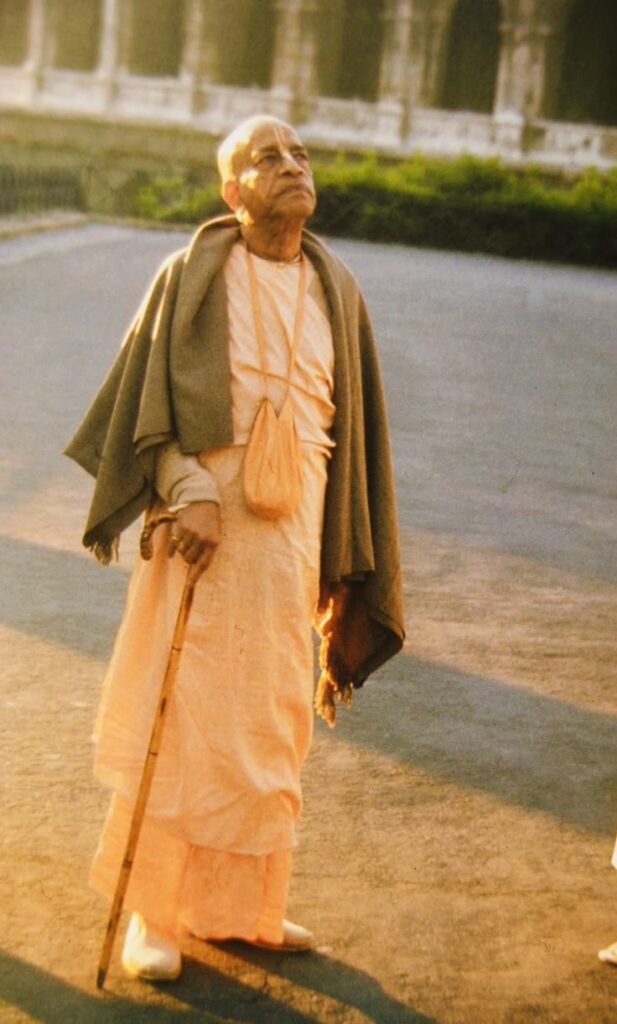
Wisdom from Srila Prabhupada
Material strength without spiritual understanding is ultimately weakness. Real strength comes from dependence on Krishna, not on one’s own arrangements.
No matter how powerful one appears, without alignment to Krishna (the Supreme Truth), the foundation remains unstable.
True power is not in how much control we have over the world…
but in how deeply we are connected to the Divine.
