Who Are You, Really? Wisdom of Bhagavad Gita
You have a name. A face. A nationality. A profession.
A body that was born, that grew, that changes every single day.
But tell me honestly — is any of that… actually you?
Stop for a moment. Look at your hand. You call it my hand — not I am the hand. You say my body — not I am the body. Language itself carries a clue we have always ignored. There is a possessor and a possession. There is a you — and then there is what belongs to you. And yet, somehow, across the whole of human civilisation, we have made the same catastrophic error: we have confused the two.
We have taken the coat for the person wearing it (that too temporarily).
This is not a poetic metaphor. According to the oldest and deepest body of wisdom on this earth — the Vedic tradition — this confusion is the single root cause of every fear, every grief, every suffering that a human being experiences. The ancient sages called it ahamkara — false ego. The fatal case of mistaken identity.
THE BODY THAT IS NOT YOU
Consider what the body actually is. You were once a child — that child’s body is entirely gone now, replaced cell by cell, year by year. The body you had at seven years old shares almost nothing material with the body you inhabit today. And yet — you remember being seven. You, the witness, the experiencer, the one inside — you remained constant while the body changed completely.
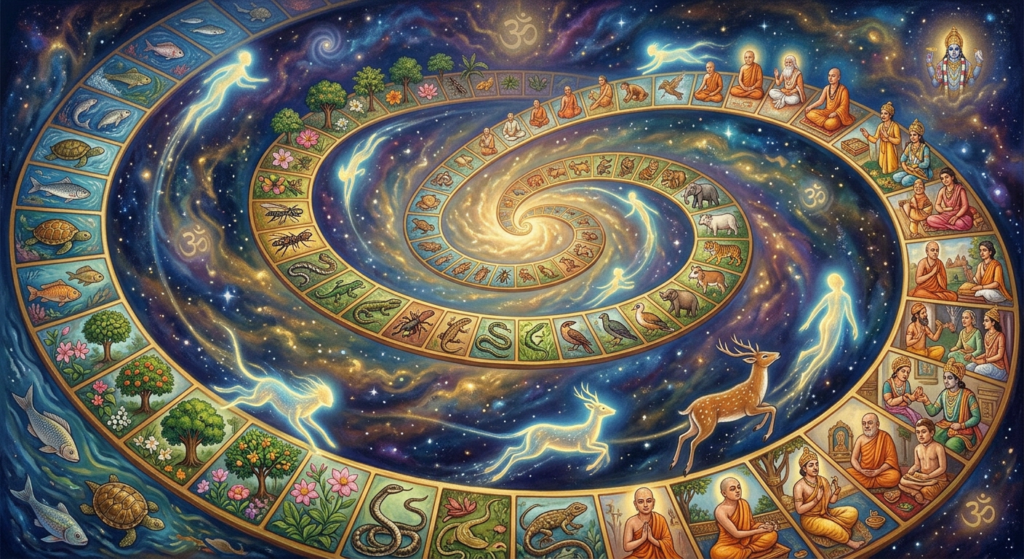
Who was it that remained?
“As the embodied soul continuously passes, in this body,
from boyhood to youth to old age, the soul similarly passes into another body at death.
A sober person is not bewildered by such a change.” BHAGAVAD GITA, 2.13
The body ages. The soul does not. The body is born. The soul is not. The body will one day be left behind in a grave or on a funeral pyre. And the soul — you — will simply move on, as naturally as a person removes a worn-out garment and reaches for a new one. And in reality we never leave this vicious cycle of being born and living a life, be it in any form or body.
This is not mysticism. This is the Vedic science of identity.
WHAT THE ANCIENT SEERS DECLARED
Long before modern science began asking questions about consciousness, the Upanishads had already mapped the terrain of the self with breathtaking depth. In the Katha Upanishad, the God of Death himself — Yama — reveals the truth of the soul to a young boy named Nachiketa:
“The soul is never born nor dies at any time. It has not come into being,
does not come into being, and will not come into being. It is unborn, eternal, ever-existing, and primeval.”
— KATHA UPANISHAD, 1.2.18
The Mundaka Upanishad offers one of the most beautiful images in all of sacred literature — two birds sitting on the same tree. One bird eats the fruits of the tree — it enjoys, it suffers, it reacts. The other bird simply watches, untouched, serene. The eating bird is the individual soul caught in the drama of material life. The watching bird is the Supersoul, the divine witness. And the tree? The tree is this very body.
Two inhabitants. One house. And most of us have spent our entire lives believing we are only the restless, eating bird — never suspecting there is a deeper, eternal self also present, watching quietly from within.
“The soul can never be cut by any weapon, nor burned by fire, nor moistened by water,
nor withered by the wind.”— BHAGAVAD GITA, 2.23
5 Steps to transform your Life. BHAKTIBLOOM
No surgeon’s scalpel can touch it. No disease can corrode it. No catastrophe can extinguish it. The soul is the one thing in your entire existence that is absolutely indestructible.
Srila Prabhupada’s Mirror
His Divine Grace A.C. Bhaktivedanta Swami Prabhupada spent his entire life holding this mirror up to a world that had forgotten itself. With disarming simplicity and devastating clarity, he brought the Vedic truth of the soul to every corner of the world.
“We are not these bodies. I am not an Indian, you are not an American.
These are just designations of the body. We are all pure spirit souls,
eternal servants of Krishna.”— SRILA PRABHUPADA
He described our condition in this material world with a single word that carries the weight of the entire Vedic teaching:
Homesick.
The soul is homesick. Every longing you have ever felt — for love that doesn’t end, for joy that doesn’t fade, for a peace that the world never quite delivers — that is not the body speaking. That is the soul, remembering something it has almost forgotten. Reaching for a home it can barely describe.
“The soul covered by maya is like the sun covered by clouds. The sun hasn’t gone anywhere —
it is still there, full of light. Spiritual practice simply removes the clouds.”
— SRILA PRABHUPADA
THE QUESTION THAT CHANGES EVERYTHING
So here is where we arrive. Not at an answer — but at a question.
The most important question a human being can ever sit with:
If I am not this name, not this face, not this nationality, not this body — then who, exactly, am I?
The Brahma Sutras open with precisely this inquiry — Athato brahma jijnasa — “Now, therefore, let there be inquiry into the Absolute.” This, the sages declared, is the purpose of human life. Not to eat, sleep, work and die. But to wake up — to recognise the self as soul, and the soul as eternally, inseparably connected to the Supreme.
You have been many things in this life. Many roles, many bodies perhaps across many lives. But underneath every role, beneath every change, before every name you were ever given — there is something that has always been still here.
Unchanged. Unborn. Undying. Watching.
That is you.
The real you.
And it has been waiting — patiently, eternally — for you to finally look in the right direction and recognise it.
Hare Krishna, Hare Krishna, Krishna Krishna, Hare Hare
Hare Rama, Hare Rama, Rama Rama, Hare Hare
THE MAHA MANTRA — THE SOUL’S CRY AND ITS ANSWER
Based on the teachings of the Vedas, Upanishads, Bhagavad Gita,
Srimad Bhagavatam, and His Divine Grace A.C. Bhaktivedanta Swami Prabhupada
Follow us on INSTAGRAM Bhaktibloom for more Bhagavad Gita Content
