First 5 Shlokas of Bhagavad Gita
The Bhagavad Gita does not begin with Krishna speaking.
It begins with a question. Not from a warrior. Not from a saint. But from a blind king.
The Blind King’s Question (Shloka 1.1)
- “Dhritarashtra said:
O Sanjaya, after assembling on the holy field of Kurukshetra and desiring to fight, what did my sons and the sons of Pandu do?”
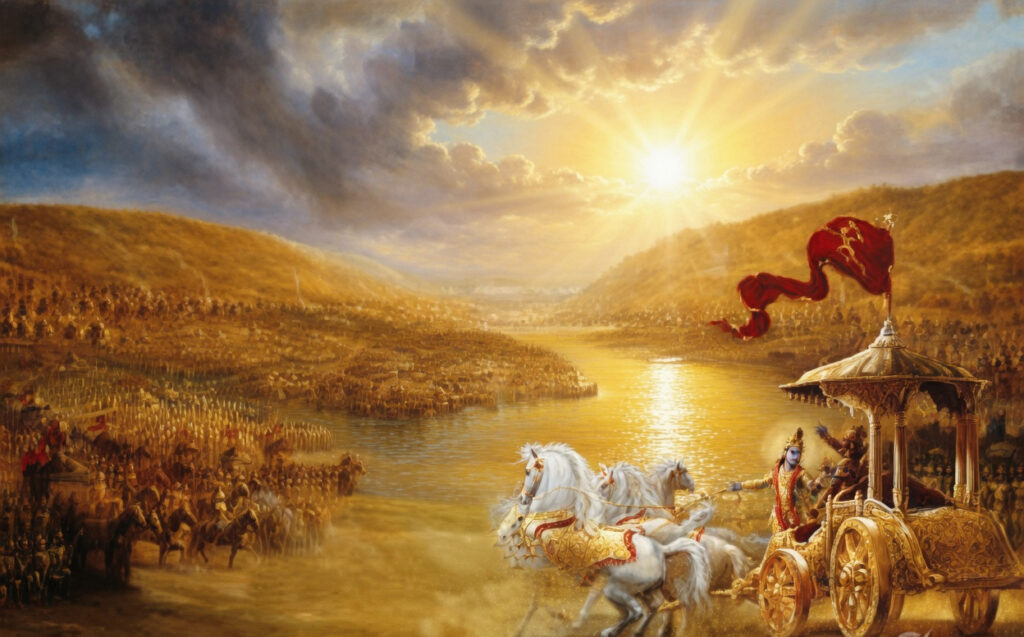
The air is heavy on the battlefield of Kurukshetra, where thousands of warriors stand ready as dust rises beneath their feet and tension fills the horizon. This is not just a war about land or power—it is the moment where destiny itself is about to unfold. Far away from this battlefield sits King Dhritarashtra, blind since birth, yet his deeper blindness lies in his attachment. Turning to Sanjaya, he asks,
“O Sanjaya, what did my sons and the sons of Pandu do after assembling on the holy field of Kurukshetra?” His question reveals everything—there is no concern for righteousness, no desire for peace, only attachment to “my sons.” In that moment, Dhritarashtra represents the human condition where attachment clouds judgment and truth is ignored even when it stands right before us.
Duryodhana Observes the Army (Shloka 1.2–1.3)
Meanwhile, on the battlefield, Duryodhana surveys the Pandava army and feels a subtle disturbance within. What he sees is not weakness, but strength—an organized, determined force ready for dharma-yuddha. He approaches his teacher, Dronacharya, not with humility but with calculation, choosing his words carefully.
Though he speaks with respect, his intention is to influence, to control, to assert confidence even when doubt begins to creep in. As he starts naming the warriors—Bhima, Arjuna, Satyaki, Virata, Drupada—each name echoes like a reminder of the formidable strength standing against him. These are not ordinary fighters; they are warriors aligned with purpose and righteousness. And despite his outward composure, Duryodhana’s inner confidence begins to shake, for even the strongest ego cannot remain steady in the presence of truth.
According to Bhagavad Gita As It Is, this moment reveals more than just military assessment—it exposes Duryodhana’s inner anxiety. Although he stands on a vast and powerful side, he cannot ignore the spiritual strength and righteousness backing the Pandavas. Their power is not merely physical; it is rooted in dharma and guided by the presence of Lord Krishna. Thus, even before the battle begins, it becomes clear that true strength lies not only in numbers or skill, but in alignment with righteousness and divine support.
The Strength of the Pandava Army (Shloka 1.4–1.5)
Duryodhana begins listing the warriors:
“Here are mighty heroes—Bhima, Arjuna… great fighters like Satyaki, Virata, and Drupada…”
Each name carries weight.
Each warrior is a legend.
And as he lists them, something subtle happens—
His confidence starts to shake.
Why?
Because truth is undeniable.
Meaning
Even the most arrogant person
recognizes strength when they see it.
Truth doesn’t need validation—
it reveals itself.
Modern Reflection
When we are on the wrong side,
we often overanalyze the strength of others.
Not because they are stronger—
but because we lack inner clarity.
Modern Implementation & Key Takeaways
The opening verses of the Bhagavad Gita remind us that life’s greatest battles are not fought outside, but within. Through Dhritarashtra’s attachment and Duryodhana’s ego, we see how confusion and insecurity can cloud judgment, even in critical moments. The strength of the Pandavas shows that true power comes from aligning with dharma and divine guidance, not just external abilities. Ultimately, before Krishna speaks, the Gita teaches us to first recognize our inner conflicts—because only then can we be ready to receive true wisdom and make the right choices in our own Kurukshetra.
The teachings from these opening verses can be applied directly to our daily lives. Like Dhritarashtra, we often become blinded by attachment—whether to people, outcomes, or comfort—and ignore what we know is right. Like Duryodhana, we may act with confidence on the outside while internally struggling with comparison, insecurity, or ego.
The lesson is to pause and become aware of these inner tendencies before making decisions. In modern life, this means choosing integrity over convenience, staying calm under pressure, and aligning our actions with higher values rather than short-term gains. Just as the Pandavas drew strength from dharma and Krishna’s presence, we too can find clarity and stability by staying connected to spiritual wisdom—through reflection, prayer, or mindful living—especially when facing our own “battlefield” moments.